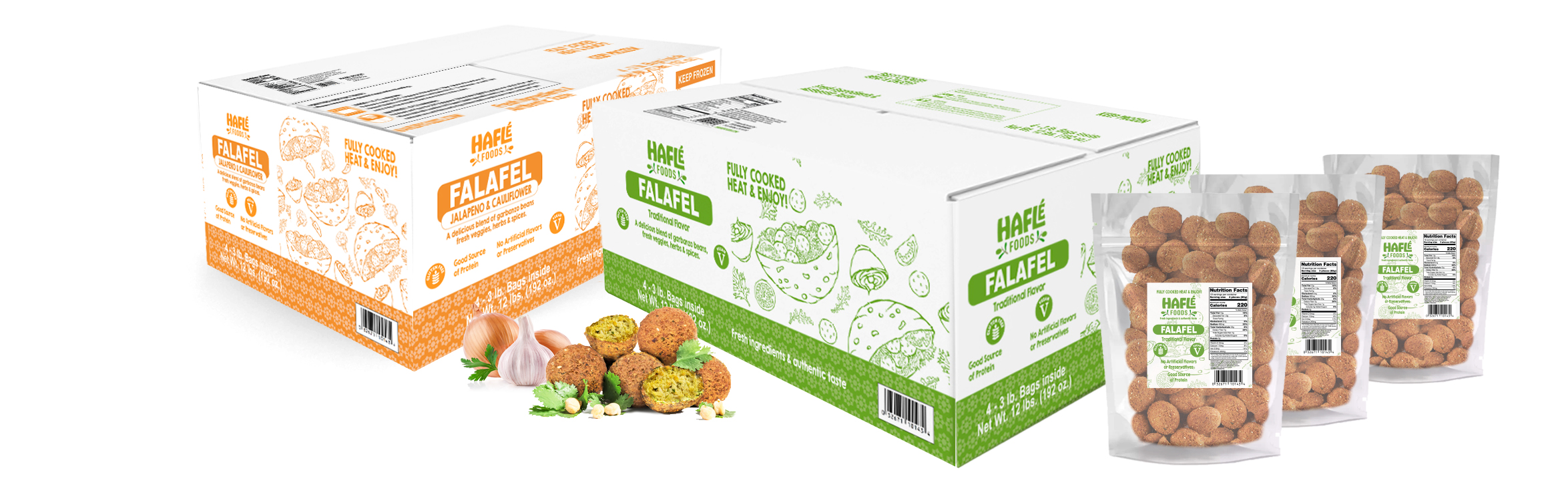
Fully Cooked Falafel
Fully Cooked Falafel for Fast, Efficient Service
Fully cooked means the falafel is finished on our line and ready for service as soon as it’s hot. There is no scratch mixing, no forming, no frying, and no fryer to manage. For a kitchen team, that translates into the kind of plant-based protein you can add to a menu without rebuilding the back of house, and for a distributor, it translates into an SKU that fits into existing frozen distribution networks without specialized handling.
The format is a strong fit for cafés, delis, restaurants, caterers, concession stands, hotel banquets, and quick-service operations that want a clean Mediterranean menu addition without additional complexity. Operators running plant-forward menus get a reliable vegan and gluten-free protein from a single SKU. Quick-service kitchens get a sandwich, wrap, or bowl component that finishes in the oven they already have. Catering teams get a product that travels well and reheats cleanly across a long service window. Concession operators get a product that can hold up during peak rush in warmer conditions without falling apart.
For institutional buyers in particular, fully cooked falafel solves a procurement problem. One SKU covers vegan, vegetarian, and gluten-free guest needs across a campus or healthcare system, simplifying inventory and shortening the menu-engineering conversation when a new daypart launches.
Simple Preparation for Busy Commercial Kitchens
Because the product is fully cooked, finishing is a heating step rather than a cooking step. It works in a convection oven, an air fryer, a flat top, a panini press, or a microwave when speed is the priority. That flexibility matters in real kitchens, where a Saturday brunch line, a Wednesday school lunch, and a Friday catering pickup all run through the same equipment and the same staffing model.
For operations, that simplicity adds up. Less prep time per cover means lower labor cost on the menu item, which often makes the difference between a vegan SKU that earns its place on the menu and one that gets cut at the next review. Fewer cooking variables mean more predictable service speed across shifts and locations, which matters for multi-unit operators trying to maintain a quality standard. And consistent output across stations means that a single-unit operator and a multi-unit chain can both rely on the same product spec to behave consistently, batch after batch.
Storage is straightforward. The product can be stored in a standard commercial freezer until needed, with a long usable shelf life that supports irregular ordering cycles. There is no fryer oil to manage at the end of service, no batter to discard, and no scratch-prep window to plan around. For operators looking to add a Mediterranean menu item without expanding back-of-house complexity, those zero-equipment operational details are usually the biggest unlock.
Menu Uses That Expand Daypart and Service Flexibility
Fully cooked falafel is one of the more flexible plant-based proteins available to a foodservice menu. Common applications include:
- Pita sandwiches and wraps with tahini, hummus, and fresh vegetables
- Grain bowls over rice, quinoa, or farro with cucumber, tomato, and herbs
- Composed salads with greens, pickled red onion, and a tahini drizzle
- Appetizer plates and mezze platters paired with hummus and olives
- Sides for plate lunches, kids’ menus, and catering trays
- Grab-and-go meals, prepared meal programs, and meal-kit components
- Concession-style portions for stadiums, airports, and event venues
- Hotel banquet platters and corporate catering spreads
The product fits Mediterranean-forward menus naturally and lands cleanly with health-forward, vegan, and globally inspired concepts as well. For institutional buyers, it covers vegan, vegetarian, and gluten-free guests from a single SKU, which is often the deciding factor for school, healthcare, and corporate dining programs that need to satisfy a wide range of dietary needs without expanding procurement complexity. Caterers and prepared meal programs use it because it reheats cleanly and holds its shape during transport.
For recipe direction across bowls, wraps, and platters, our falafel bowl recipe guide covers build patterns that translate directly to operator menus, and our falafel cooking methods guide walks through finishing strategies for ovens, air fryers, flat tops, and microwave service. A drizzle of authentic tahini sauce finishes most applications cleanly.
Product Qualities Buyers Are Looking For
The recipe uses garbanzo beans, fresh herbs including parsley and cilantro, garlic, onion, and traditional Mediterranean spices like cumin and coriander. Nothing artificial, no fillers that read strangely on a label, and no ingredients that complicate clean-label commitments. The product is naturally vegan, certified gluten-free, and produced in a facility that takes those positioning claims seriously enough to maintain SQF certification.
Consistency is the other quality buyers ask about most. Each piece comes off the line at the same portion weight, diameter, and texture profile. That means predictable plate cost, reliable portion control for institutional and catering applications, and a finished product that crisps and tastes the same in March as it does in October. For procurement teams writing specs for a multi-location program, those consistency metrics are often more important than any single quality claim, because they determine whether the program actually scales.
For schools, healthcare, corporate dining, and other health-conscious institutional settings, those attributes matter beyond taste. Inclusive menu options that cover vegan, vegetarian, and gluten-free needs from one SKU reduce procurement complexity and make it easier to satisfy a wider range of guests without expanding the inventory list. For a school nutrition director balancing allergen tracking, federal nutrition guidelines, and student preferences, that single-SKU coverage is genuinely useful.
Bulk Orders, Distribution, and Private-Label Options
Hafle Foods has been manufacturing authentic Mediterranean foods for over fifty years. Our SQF-certified production facility runs continuous quality testing from inbound chickpea lots through final pack, and our supply has been steady enough to support both specialty distribution and major retail chains, including Costco and Trader Joe’s. For foodservice partners, that production base translates into predictable lead times, consistent product across runs, and the ability to scale with a buyer as their program grows.
For distributors and private-label buyers, our capabilities include flexible pack configurations ranging from boutique specialty quantities to high-volume contracts, custom packaging with client branding, portion-controlled formats for institutional requirements, and recipe customization as needed. Bulk foodservice packaging minimizes waste and storage requirements, while extended shelf life through advanced freezing techniques supports irregular ordering cycles. Read more about our heritage and manufacturing capability on the About Hafle Foods page, or explore our broader Frozen Foodservice solutions hub for the full operator picture.

 Fully Cooked Falafel